As a teacher, when I share that I teach a mixed-age Montessori class, I often encounter a flurry of questions. I can relate, as I too had many inquiries before venturing into this enriching teaching environment, and I continue to ponder various aspects of it even now.
Before delving into the intricacies of what it means to be a mixed-age Montessori teacher, it is essential to first address the foundation of this educational approach. What exactly is Montessori, and why does it hold such significance in the realm of education?
What is Montessori Education?
Montessori education is an innovative approach to learning, developed by Italian physician and educator Dr. Maria Montessori in the early 20th century. It emphasizes child-led learning, where students are encouraged to take an active role in their education. This method not only nurtures independence but also fosters critical thinking skills and a love for learning.
Key Highlights of Montessori Education
- Child-Centered Learning: At the heart of Montessori is the belief that children are natural learners. They learn best when they are allowed to explore their interests at their own pace within a prepared environment.
- Mixed-Age Classrooms: One of the standout features of the Montessori method is its mixed-age classrooms. In these settings, children of various ages learn from and alongside each other, fostering collaboration, empathy, and social skills. Younger students benefit from observing and interacting with older peers, while older students reinforce their understanding by teaching concepts they have already mastered.
- Prepared Environment: The physical space in a Montessori classroom is intentionally designed to facilitate exploration and learning. Materials are accessible and varied, allowing children to engage with their environment in meaningful ways.
- Holistic Development: Montessori education addresses not just academic growth, but emotional, social, and physical development as well. It aims to cultivate well-rounded individuals who are not only knowledgeable but also capable of making thoughtful choices and contributing positively to society.
- Respect for the Child: Central to Montessori philosophy is the respect for each child as an individual with unique needs, interests, and abilities. In this nurturing environment, educators support children’s development without imposing rigid structures or guidelines, allowing for personalized learning experiences.
By understanding these fundamental principles of Montessori education, one can begin to appreciate the transformative potential it holds for students, particularly in a mixed-age learning context. It creates a rich tapestry of experiences, knowledge, and interaction that prepares children not only for academic success but for life beyond the classroom.
As we journey together into the role of a mixed-age Montessori teacher, it’s important to recognize the dynamic and rewarding nature of this educational approach that can leave a lasting impact on both educators and students alike.
A Montessori education emphasizes understanding each child’s unique needs and tailoring lessons to their developmental readiness. This approach not only accommodates students at their current academic level but also aligns with their personal interests. For instance, I have a second grader who has shown a keen fascination with multiplication. Although this concept is typically introduced in grade three, I recognize his eagerness to learn and have begun incorporating multiplication into our individualized lessons. Over the past few weeks, I’ve observed remarkable progress; he has been diligently creating his own multiplication problems in his notebook. It is truly rewarding to witness his enthusiasm and determination as he embraces more challenging material, demonstrating that with the right support, every child can thrive and excel.
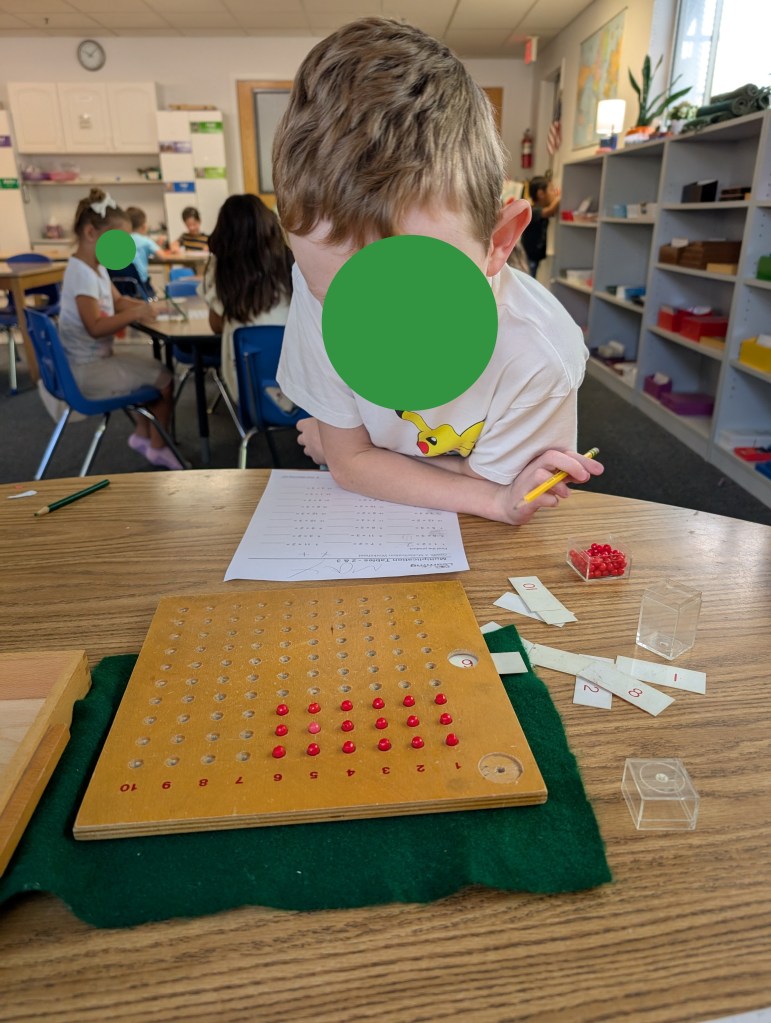
” At some given moment, it happens that the child becomes deeply interested in a piece of work; we see it in the expression on his face, his intense concentration, the devotion to the exercise” – Dr. Maria Montessori.
Montessori students are embraced within a close-knit, nurturing community that fosters both emotional and intellectual growth. The teachers cultivate strong, empathetic relationships with both parents and students, leading to a warm and secure environment where children feel empowered to explore and learn. This is one of the many reasons I am passionate about teaching in a mixed-age classroom. Over the course of four years, I have the privilege of watching my students grow and develop, while also forming incredible bonds with their families. Together, we collaborate as a cohesive team, maintaining open lines of communication that enhance the educational experience and ensure that each child’s unique needs are met. This partnership between educators and families not only enriches the learning process but also builds a sense of belonging that lasts well beyond the classroom.
Do you have a child attending a Montessori school? Or perhaps you’re considering enrolling your child in one? I would be thrilled to hear your thoughts, experiences, and any questions you may have!

COMMON FAQS:
What is the Montessori Method?
The Montessori Method is a child-centered educational approach developed by Dr. Maria Montessori. It emphasizes hands-on, self-paced, and collaborative learning in a carefully prepared environment. The goal is to foster independence, curiosity, and a lifelong love of learning. Children are given the freedom to choose their activities and work at their own pace, guided by trained teachers.
How does Montessori differ from traditional education?
Here’s a table highlighting some key differences:
| Feature | Montessori Education | Traditional Education |
|---|---|---|
| Learning Style | Active, hands-on, self-directed | Passive, teacher-led, often lecture-based |
| Curriculum | Flexible, individualized, follows child’s interests | Fixed, uniform for all students |
| Pacing | Child-led, individual pace | Teacher-paced, all students progress at the same rate |
| Classroom | Multi-age groupings, prepared environment with materials | Single-age groupings, desks facing the teacher |
| Teacher’s Role | Guide, facilitator, observer | Instructor, lecturer, director |
| Assessment | Observation, portfolios, individual progress | Tests, grades |
| Motivation | Intrinsic, based on interest and mastery | Often extrinsic, based on grades and rewards |
| Discipline | Focus on self-discipline and responsibility | Often relies on external rewards and punishments |
What are the core principles of Montessori education?
The five core principles are:
- Respect for the Child: Recognizing each child as a unique individual with their own potential and learning style.
- The Absorbent Mind: Understanding that children, especially in their early years, have an exceptional capacity to absorb information from their environment effortlessly.
- Sensitive Periods: Recognizing specific periods in a child’s development when they are particularly receptive to learning certain skills or concepts.
- The Prepared Environment: Creating a carefully organized and stimulating classroom that supports the child’s independence and exploration.
- Auto-education: Believing that children are capable of teaching themselves through interaction with the prepared environment and materials.
What will my child do in a Montessori classroom?
In a Montessori classroom, you’ll typically see children:
- Choosing their own work: They select activities that interest them from the available materials.
- Working independently or in small groups: They engage in hands-on activities at their own pace.
- Using specially designed materials: These materials are often self-correcting and designed to teach specific concepts.
- Having uninterrupted work periods: Longer blocks of time allow for deeper concentration and engagement.
- Receiving individual or small group lessons: Teachers introduce new materials and concepts as needed.
- Engaging in practical life activities: These activities help develop independence and life skills (e.g., pouring, dressing, cleaning).
- Exploring sensorial materials: These materials help refine their senses and build a foundation for abstract learning.
What are the benefits of a multi-age classroom?
Montessori classrooms typically group children in three-year age spans (e.g., 3-6 years, 6-9 years). This offers several benefits:
- Peer learning: Younger children learn by observing older children, and older children reinforce their learning by helping younger ones.
- Leadership skills: Older children have opportunities to act as mentors and role models.
- Social development: Children learn to interact with a diverse group of peers.
- Individual pace: Children are not limited by the pace of their same-age peers.
- Stronger teacher-student relationships: Teachers often stay with the same group of children for three years, fostering deeper understanding and connection.
How is discipline handled in a Montessori classroom?
Discipline in a Montessori classroom focuses on developing self-discipline, responsibility, and respect for oneself, others, and the environment. Teachers guide children in understanding the impact of their actions and encourage problem-solving and conflict resolution. The prepared environment and clear boundaries also contribute to a well-ordered and respectful atmosphere.
Will my child be prepared for traditional schooling after attending Montessori?
Yes, Montessori students generally transition well to traditional schools. They often develop strong academic foundations, independence, problem-solving skills, and social-emotional maturity, which are valuable in any educational setting. Research suggests that Montessori students perform as well as or better than their peers in traditional schools, both academically and socially.
How can I choose the right Montessori school for my child?
Choosing the right school is an important decision. Here are some things to consider:
- Visit the school: Observe the classrooms in action. Are the children engaged and focused? Is the environment calm and orderly? Do the teachers interact respectfully with the children?
- Ask about teacher qualifications: Are the teachers trained and certified in the Montessori method for the age group they teach (e.g., by AMI or AMS)?
- Inquire about the curriculum: Does it cover a full range of subjects, including practical life, sensorial, language, math, science, and culture?
- Consider the school’s philosophy and values: Do they align with your own?
- Ask about parent involvement: What opportunities are there for parents to be involved in the school community?
- Check for accreditation: Accreditation by organizations like AMS (American Montessori Society) can indicate a commitment to authentic Montessori practices.
- Talk to other parents: Get their perspectives on the school.
With love,
Samantha Staggs

 Modern Montessori
Leave a comment